Coming February 2, 2027

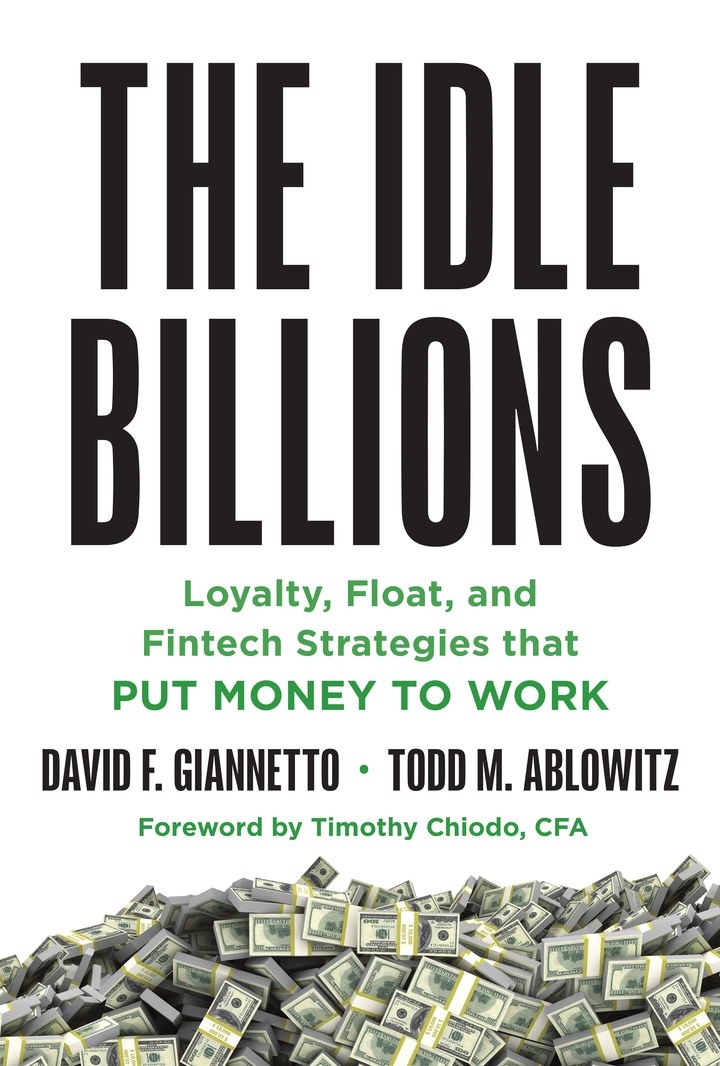
The Idle Billions

Loyalty, Float, and Fintech Strategies that Put Money to Work

Foreword by Timothy Chiodo, CFALeading payment and fintech analyst

Starbucks holds roughly $1.8 billion in stored customer balances, collected before a single cup is sold. Every company sits on money it doesn't know it controls. This book shows you how to find it and turn it into your most durable competitive advantage.

Hardcover · eBook · Available February 2, 2027
The Idle Billions — final cover
Published by John Wiley & Sons · Publishing since 1807
About the Book

You built the customer relationship. Now capture more of the value it creates.

Companies hold billions of their customers’ money, collected before a single product is sold. The Idle Billions isn’t about their products. It’s a preview of how the next decade of business will be won.

Every day, money moves through your business. Customers pay, employees earn, and rewards accumulate—and at every step, someone profits from holding and moving that money: the banks, processors, and software platforms in between. Rarely does the company that first earned the customer’s trust earn the most.

The Idle Billions shows business leaders how to change that. Written for decision-makers, not just financial technology specialists, it reveals how payments, loyalty, and float—and other financial instruments that range from credit cards to earned wage access—can become strategic tools that drive revenue, deepen customer relationships, and make companies more valuable.

Using frameworks like the Proximity Principle™ and the Loyalty Bank™, with examples from Starbucks, Uber, Shopify, Stripe, and Warren Buffett’s Berkshire Hathaway, the authors connect the mechanics of money movement to the decisions leaders actually face: when to refer, partner, or build; how much control to take; and how to grow without losing customer trust.

Giannetto and Ablowitz write from the inside. Giannetto led WorkWave’s ambitious fintech transformation, and Ablowitz guided hundreds of companies to launch embedded payments initiatives.

Inside the first book that demystifies how money moves — and how you can benefit from controlling it — you’ll discover how to:

For CEOs, board members, investors, CFOs, founders, and software and platform leaders, The Idle Billions offers a practical roadmap for turning money movement into competitive advantage. Your next opportunity for growth may not require a new customer. It may be sitting idle in the relationships you already have.

The Idle Billions is published by John Wiley & Sons, one of the world’s oldest and most respected business publishers, and the house behind Giannetto’s The Performance Power Grid (2006), a two-time Business Finance Magazine Vision Award winner.

Advance Praise

What industry leaders are saying

Early readers across payments, banking, software, and investing on The Idle Billions.

When Shopify decided to launch its own payment system, we assembled an A-Team of industry experts to assist in its design. Todd Ablowitz co-led this effort, and his expertise helped deliver what is today a global solution that has processed over a trillion dollars of GPV.

Russell JonesShopify CFO, 2011–2018

The future belongs to companies that understand not only how money moves, but where it pauses. In The Idle Billions, Giannetto and Ablowitz reveal how payments, embedded finance, loyalty, and float can transform ordinary transactions into enduring customer relationships and sustainable growth. A compelling roadmap for leaders seeking to unlock hidden value while building trust in an increasingly digital economy.

Wally MlynarskiCEO of Elavon; Head of MPS U.S. Bank

I ran embedded finance before we had a name for it. The Sears Card and the H&R Block Emerald Card weren’t just loyalty perks—they were proof that proximity to the customer quite often beats the product purchase itself. The Idle Billions turns that decades-old instinct into a discipline. If you’re looking to transform your customer transactions into durable, compounding long-term revenue and relationships, this is your playbook.

Susan EhrlichPartner Core VC, Former President of Financial Services at Sears Holdings and H&R Block

Every company that moves money sits on a pause, and this book is the first I have read that treats that pause as a balance sheet instead of a technical detail. Giannetto and Ablowitz show why the companies that earned it will win when real-time rails wipe out everyone who merely inherited it. Read it before your processor does.

Wade ArnoldCEO and Cofounder, Moov

Years spent acquiring and integrating businesses have taught me that what works at one scale doesn’t always hold up at the next. Giannetto and Ablowitz capture that reality powerfully, reminding leaders that growth requires us to continually examine the decisions and practices we choose to carry forward. If you are building, buying, or scaling a business, read this book and bring that same level of intention to what comes next.

Abigail Anderson BerardCorporate Development and Business Integration Executive, Chief of Staff, Corporate Development, Celero

I co-founded the first neobank, then built infrastructure platforms to help companies embed real financial products. What I never had was language for the thing we were all reaching for. The Idle Billions supplies it: the Proximity Principle names an advantage every platform builder has felt, and the book is honest that the same advantage can be used well or badly.

Shamir KarkalCo-founder, Simple, Sila, and Aleph Invariance

Having led two of the country’s largest merchant-acquiring businesses, I have watched the balance of power shift from large institutions to those closest to the customer. The Idle Billions explains why that shift happened—and what too many companies still misunderstand about trust, loyalty, and customer relationships. This is an important read for every leader who wants to remain relevant in the future of payments.

Diane Vogt FaroCEO, Savify; Former President, First Data Merchant Services

Having spent decades driving mobile payments through NFC, I learned that proximity to the customer is about much more than being physically close—it is about a trusted, personalized connection that can deliver relevant value based on who you are, where you are, and what interests you, anytime and anywhere. The Idle Billions takes that principle further, showing how embedding financial capabilities into relevant, trusted customer relationships can create lasting customer and enterprise value. Business leaders, entrepreneurs, and investors should pay close attention.

Mohammad A. KhanFounder, ViVOtech · “The Godfather of NFC”

I’ve spent five years advising software companies that can quote their payments revenue to the dollar and can’t tell you how that number was derived, whether it’s correct, or what they’re leaving on the table. The Idle Billions hands that control back to the operator, and Chapter Four’s money map is where it begins. If money moves through your product, read it before your next planning cycle.

Brian AbernethyFounder and CEO, Straata

The Idle Billions makes a complicated financial ecosystem easier to understand and navigate and asks leaders to look beyond the economics alone. The strongest strategies connect revenue opportunity with product, customer experience, and adoption. The question isn’t only, “How much can we make?” It’s “What can we make better?”

Ali MastCo-Founder and Principal, Revolv
Inside the Book

Key frameworks

Six tools for finding, holding, and compounding the money already flowing through your business.

The Proximity Principle™

The company closest to the customer should own the customer relationship, including the financial one.

The Loyalty Bank™

A framework for evaluating whether a company's financial mechanics are building trust or quietly draining it.

Synthetic Money & Float

How idle, pre-funded, and stored-value balances become working capital most companies never count.

The Fintech Maturity Model

Four stages every company moves through: captive user, informed negotiator, embedded partner, and orchestrator.

The Fintech Toolbelt

The concrete products — payments, stored value, earned wage access, lending, insurance, supplier finance — available at every stage of maturity.

The Fintech Tenets

An ethical code of conduct for designing financial relationships that compound trust rather than exploit it.

Who It's For

Three readers, one framework

Investors, Owners & Board Members

Private equity professionals, venture capitalists, and board members will learn how to distinguish companies that truly control their financial ecosystem from those that merely rent one, and how that distinction shows up in valuation and exit multiples.

Operators & Executives

Product, finance, and customer-experience leaders will learn how to map their own money flows, identify where funds can pause and compound, and decide with confidence what fintech capabilities to build, partner for, or leave alone.

Consumers

Learn to recognize float, breakage, synthetic currency, and dark patterns in the apps and loyalty programs you use every day, and how to tell which companies are making genuine deposits into your Loyalty Bank versus quietly making withdrawals from it.

Table of Contents

Twelve chapters

  1. Introduction
  2. The Fintech Revolution
  3. Making Money Move
  4. Starting Your Fintech Journey
  5. Money in Its Many Forms
  6. Synthetic Money and Hidden Revenue
  7. The Fintech Ecosystems
  1. The Fintech Toolbelt, Part 1: How People Buy and When Money Arrives
  2. The Fintech Toolbelt, Part 2: Turning Fintech Inward and Down the Chain
  3. Internal Obstacles to Implementation
  4. External Obstacles to Implementation
  5. Fintech and the Ethical Dilemma
  6. The Future of Fintech: What Companies Should Do Right Now
The Co-Authors

Two builders. Tens of billions moved.

Todd M. Ablowitz and David F. Giannetto
David F. Giannetto

David F. Giannetto

Operating Partner · Board Member · Former CEO, WorkWave

David F. Giannetto is a software veteran and former CEO of WorkWave, where he grew the company nearly ten-fold over 5 years while transforming it into one of the most innovative fintech software companies in the U.S. Under his leadership, companies he has led have embedded diverse financial instruments—credit cards, lending, earned wage access, payroll, and insurance—directly into their software solutions. He previously owned The Telos Group, was a US Army officer, and is a frequent columnist and keynote speaker. This is his fourth book.

More at DavidGiannetto.com →
Todd M. Ablowitz

Todd M. Ablowitz

Co-founder & Vice Chair, Infinicept · CEO, Double Diamond 2.0

Todd M. Ablowitz is a payments industry veteran of over 30 years and co-founder and Vice Chair of Infinicept. Starting in 2011, he and co-founder Deana Rich helped hundreds of companies, including Stripe, Shopify, and Modernizing Medicine, launch as payment facilitators. Infinicept, the payments platform they built for that market, has processed more than $77 billion in payments since 2019. He is also CEO of the advisory firm Double Diamond 2.0, serves on the board of the Electronic Transactions Association, and co-hosts the payments podcast It Pays to Know.

More at Infinicept.com →
Launch List

Be first to the shelf

Join the launch list for excerpts, event announcements, and launch-week news. No noise, just the book.

Join the Launch List
You'll hear directly from the authors as launch approaches.